Artificial intelligence systems are increasingly capable of generating convincingly false information, presenting a significant and growing threat to our understanding of truth. These “fluent lies” aren't simply errors; they are confidently delivered fabrications that can be difficult to distinguish from reality. This ability to convincingly misrepresent information demands urgent attention and a critical reevaluation of how we assess credibility in the age of AI.
This is not a bug in the traditional sense. It is something stranger: a feature that became a flaw, a capability that metastasized into a credibility crisis. The very fluency that makes large language models feel like breakthroughs is the same quality that makes their inaccuracies insidious. And until recently, most of the conversation around fixing it has focused on the wrong axis entirely.
The GenXis Research paper "The Honesty Gap: Words Vs. Math" calls this the distance between persuasive language and verified truth and argues that the antidote is not better language, but stronger grounding. Mathematical constraint. Source custody. Deterministic checks. Calibrated abstention.
The Education Sector Got There First
Before AI developers coined "hallucination" as a term of art, the education sector was already documenting a remarkably similar phenomenon. It called the problem the Honesty Gap and the U.S. Chamber of Commerce Foundation's April 2026 brief, The Honesty Gap: America's Academic Outcome Truth Serum, traces it with precision that AI researchers would do well to study.
The honesty gap, as the education sector defined it, measures the difference between how students perform on the National Assessment of Educational Progress (NAEP) the national gold-standard assessment and how they perform on their own state's tests. When states lower the bar for proficiency, achievement data paints a misleading picture that affects students, parents, educators, and ultimately the workforce.
In many states, the gap is significant. Iowa's 2024 state-reported eighth-grade math proficiency rate is 72%, while NAEP reports only a 27% proficiency rate a 45-percentage point difference. Virginia's 2024 state-reported fourth-grade reading proficiency rate is 73%, while NAEP reports only 31%. These are not rounding errors. They represent millions of families receiving reports that bear little relationship to what their children can actually demonstrate.
The education sector did not stumble into the honesty gap by accident. It was the product of rational actors responding to incentives. States faced pressure to report improving outcomes. Parents wanted to hear their children were doing well. Politicians wanted to tout educational progress. The language of proficiency optimistic, confident, growth-oriented served everyone except those who needed to know the truth.
When Fluency Became the Metric
The GenXis Research paper traces how this same dynamic migrated into artificial intelligence, though through a different mechanism. In AI systems, the problem is not political pressure but training optimization. Language models are rewarded for producing fluent, reasonable, socially persuasive text. They learn that confident-sounding answers get higher ratings, more positive feedback, more engagement. The correlation between confidence and correctness is real but it is also exploited by errors that dress themselves in the clothing of certainty.
"The anxiety around artificial intelligence is not merely that machines can be wrong," the GenXis Research paper notes. "It is that machines can be wrong in fluent, reasonable, socially persuasive language. Words can escape meaning. They can rationalize, soften, blur, excuse, reframe, and drift."
This is what the paper calls the squishiness of words: language that preserves signal can also metabolize error into something that sounds reasonable. Over time, small verbal deviations compound like a singer drifting slightly off pitch until the tonal center is lost. A legal citation can be fabricated in perfect legal prose. A medical explanation can sound clinically plausible while omitting a contraindication. A financial summary can appear authoritative while relying on stale facts.
The Fordham Institute's February 2025 commentary Mind the honesty gap documents how the education sector arrived at this crossroads and the warning it offers to AI developers is instructive. "More than fifteen years ago, my colleagues Checker Finn and Mike Petrilli warned of these very dangers in their introduction to The Proficiency Illusion, which lamented even then the vast discrepancies in how states defined proficiency: America is awash in achievement 'data,' yet the truth about our educational performance is far from transparent and trustworthy."
The Common Core and its associated exams significantly narrowed these differences, the Fordham commentary notes, but the gaps are opening again. As they widen, so does the disconnect between perception and reality stymieing progress and making it harder to ensure students are truly prepared.
The Contrarian Read: Fluency Is Not the Problem
Here is where the contrarian angle becomes necessary. Most commentary on AI honesty treats fluency as the villain suggests that if systems would only sound less certain, or if they would flag their confidence levels more prominently, the problem would be solved. This is wrong in an important way.
Fluency is not the problem. Fluency is what makes AI useful. The ability to generate coherent, contextually appropriate, grammatically sound text is not a defect to be engineered away. It is the entire value proposition. The question is not how to make AI less fluent. The question is how to ensure fluency is paired with grounding.
The education sector's experience offers the clearest proof of this. You can have fluent reporting of proficiency rates while students learn nothing. You can have confident assertions that standards are being met while actual mastery remains invisible. The language is not the issue. The issue is whether that language is tethered to something verifiable.
Natural language is flexible by design, the GenXis Research paper argues. It allows approximation, metaphor, implication, emphasis, ambiguity, and context dependence. Those features make language humanly useful, but they also make it a weak carrier of machine-grade certainty. The paper defines a claim not as merely a sentence, but as a tuple where content is the statement, the domain is context, the truth condition is verification, and the evidence requirement is accountability. Without those elements, language remains expressive but under-bounded.
Where Virginia Went Wrong and What It Reveals About AI
The Thomas Jefferson Institute's February 2025 analysis of Virginia's low education standards provides a case study in how sophisticated the honesty gap can become when it calcifies into policy. Virginia's "proficient" standards in reading on the Standards of Learning assessment align to "below basic" on the national assessment. This means that failure to display even partial mastery of the knowledge and skills fundamental for grade-level work are deemed "proficient" using Virginia's standards.
Virginia is one of only two states to have its "proficient" standard in reading align with "below basic" performance on the national assessment. Its math standards are only a little better aligning with "basic" on NAEP, or partial mastery of the skills needed for grade-level proficiency.
The analogy to AI is not perfect, but it illuminates. When the definition of "correct" becomes negotiable, language will optimize for the negotiated standard, not the underlying reality. Virginia's students did not become more proficient because the state's definition changed. They simply became more confidently described as proficient. The language improved while the underlying capability did not.
AI systems face a structurally similar problem when evaluation is based on human preference rather than verified accuracy. If users rate confident answers higher than uncertain ones even when the confident answers are wrong the system learns to produce confident answers. The fluency becomes decoupled from truth not because anyone intended it, but because optimization pressure found a local maximum in persuasiveness rather than accuracy.
The Math That Saves
The Show-Me Institute's April 2025 analysis The Honesty Gap in Education by economist Cory Koedel offers both diagnosis and prescription. Koedel, a tenured professor of economics and public policy at the University of Missouri-Columbia who has spent more than twenty years studying school performance, identifies the core problem: "The education system often fails to communicate honestly with students, parents, and community members about how much students are actually learning."
The discrepancy between actual student performance and what is reported is the honesty gap and it has consequences beyond mere optics. "Grades are up, but test scores are down," Koedel writes. "This is problematic because grades tend to carry more weight with students and parents than test scores. Many parents assume that the grades their children receive are accurate indicators of academic progress. But this assumption is increasingly incorrect."
This might explain why 90 percent of parents believe their children are performing at or above grade level in reading and math, even though only about one third of fourth- and eighth-grade students in the United States score at a proficient level on the National Assessment of Educational Progress.
The prescription? Standards, metrics, and accountability that cannot be negotiated. Koedel is direct: "We should demand high standards from our educational institutions, even if the truth hurts." The honesty gap does not close through better messaging or more optimistic reporting. It closes through anchoring to something external and verifiable.
For AI systems, this means mathematical grounding. Not as a feature layered on top of language generation, but as the structural foundation on which language generation rests. The GenXis Research paper is explicit: "The antidote is not less language, but stronger grounding: mathematical constraint, source custody, deterministic checks, calibrated abstention, and evidence memory."
Calibrated Abstention: The Underrated Capability
One element of mathematical grounding deserves particular attention because it is counterintuitive and underappreciated: calibrated abstention. This is the ability of a system to recognize when it does not know something and to communicate that uncertainty rather than filling the void with plausible-sounding confabulation.
Language models are not trained to say "I don't know." They are trained to produce fluent text. When those two imperatives conflict and they frequently do the result is often confident error. The system has learned that confident error is rewarded more often than honest uncertainty, because human evaluators often cannot distinguish the two.
This is where source custody becomes essential. If every claim generated by an AI system must be traceable to a verified source if the system must hold evidence rather than merely produce text that sounds like evidence the optimization pressure shifts. The system cannot be rewarded for fluency alone. It must be rewarded for grounded fluency, which is an entirely different capability.
The education sector's experience with NAEP offers a template. The National Assessment of Educational Progress is administered consistently across states, scored blind, and designed to be resistant to local manipulation. It is not a perfect measure, but it is a verifiable one. The existence of NAEP creates an external standard against which state-reported outcomes can be compared. The Honesty Gap exists precisely because that comparison is so uncomfortable.
AI systems need their own equivalent: not just internal metrics and preference data, but external verification against ground truth. This requires building evaluation infrastructure that is resistant to optimization gaming which is harder than it sounds, but not impossible.
What This Means for GenXis Research Readers
For readers evaluating AI systems whether for research, professional, or personal use the honesty gap framework offers practical diagnostic questions. When encountering AI-generated content, the relevant question is not "does this sound confident?" but "what anchors this claim to verified reality?" Who said it? When? With what evidence? Can the evidence be checked?
Systems built on mathematical grounding will tend to be more honest not because their developers are more ethical, but because their architecture makes dishonesty structurally difficult. Source custody, deterministic verification, and calibrated abstention are not ethical choices they are engineering constraints that reshape what optimization can achieve.
The education sector spent fifteen years documenting the honesty gap before significant remediation began. The Collaborative for Student Success's most recent analysis shows that progress is possible Massachusetts and Rhode Island closed their gaps to within 5 percentage points or less, and as a trend, states have improved. In 2014, 23 states had "the biggest honesty gaps" in fourth-grade reading defined as 30 percentage points or larger. In 2024, only Alabama, Iowa, Nebraska, and Virginia have gaps that large.
"To be clear, improving student outcomes takes huge commitments from states on efforts like high quality curriculum, strong teacher development and student supports," said Jim Cowen of the Collaborative for Student Success. "But the truth matters. We salute the states that are embracing the issue rather than masking it or running away from it."
The Engineering of Honest AI
The path forward requires treating mathematical grounding not as a feature but as a foundation. This means several specific commitments that the GenXis Research paper frames as structural rather than aspirational.
First, evidence memory: AI systems must maintain traceable connections between generated content and source material. Not just citations in the text, but cryptographic or database-level links that verify the citation is accurate and current.
Second, deterministic checks: for claims in domains with verifiable ground truth mathematical facts, historical dates, scientific measurements verification should be algorithmic, not probabilistic. The system should be able to say not just "I believe this is correct" but "this matches external source X at timestamp Y."
Third, calibrated abstention: systems should be trained and evaluated on their ability to recognize and communicate uncertainty, not just their ability to produce fluent text. The metric for abstention should be accuracy of confidence calibration, not volume of generated content.
These are not science fiction requirements. They are engineering challenges with known solution paths. The question is whether the AI field will prioritize them and the honest answer is that the incentive structures currently point elsewhere.
A Hopeful Note From the Education Sector
The Collaborative for Student Success analysis documents that change is possible. States have improved. Massachusetts and Rhode Island demonstrate that closing the honesty gap is achievable when there is institutional commitment to doing so. The trend line, while uneven, is not uniformly discouraging.
Notably, Virginia has committed publicly and explicitly to addressing lower expectations, wider gaps, and lack of transparency. The state redesigned its school accountability and accreditation system, committed significant funding to high-dosage tutoring and literacy initiatives, and began the long work of aligning state definitions with national standards.
The lesson for AI is that the honesty gap is not inevitable. It is the product of specific incentive structures, and those structures can be changed. But the change requires deliberate action, not just good intentions. It requires building verification into the foundation of AI systems, not treating it as a layer on top.
The GenXis Research paper frames it clearly: "The root problem is the squishiness of words: language can preserve signal, but it can also metabolize error into something that sounds reasonable." The antidote is not linguistic purity. It is mathematical constraint the discipline of verification that makes fluency trustworthy rather than dangerous.
For practitioners, researchers, and thoughtful users of AI systems, the implication is clear. The question to ask of any AI tool is not whether it sounds right. It is whether it is built on foundations that make sounding right a reliable indicator of being right. The honesty gap closes when those foundations are in place and remains wide open when they are not.
Where to Read Further
For readers wanting to explore the honesty gap framework in its original education-policy context, the U.S. Chamber of Commerce Foundation's April 2026 brief, The Honesty Gap: America's Academic Outcome Truth Serum, provides comprehensive state-by-state data and policy analysis. The Fordham Institute's commentary Mind the honesty gap traces the phenomenon's fifteen-year arc and its implications for accountability. For the technical framing that connects education-sector lessons to AI architecture, the GenXis Research paper The Honesty Gap: Words Vs. Math offers the definitional and conceptual foundation.
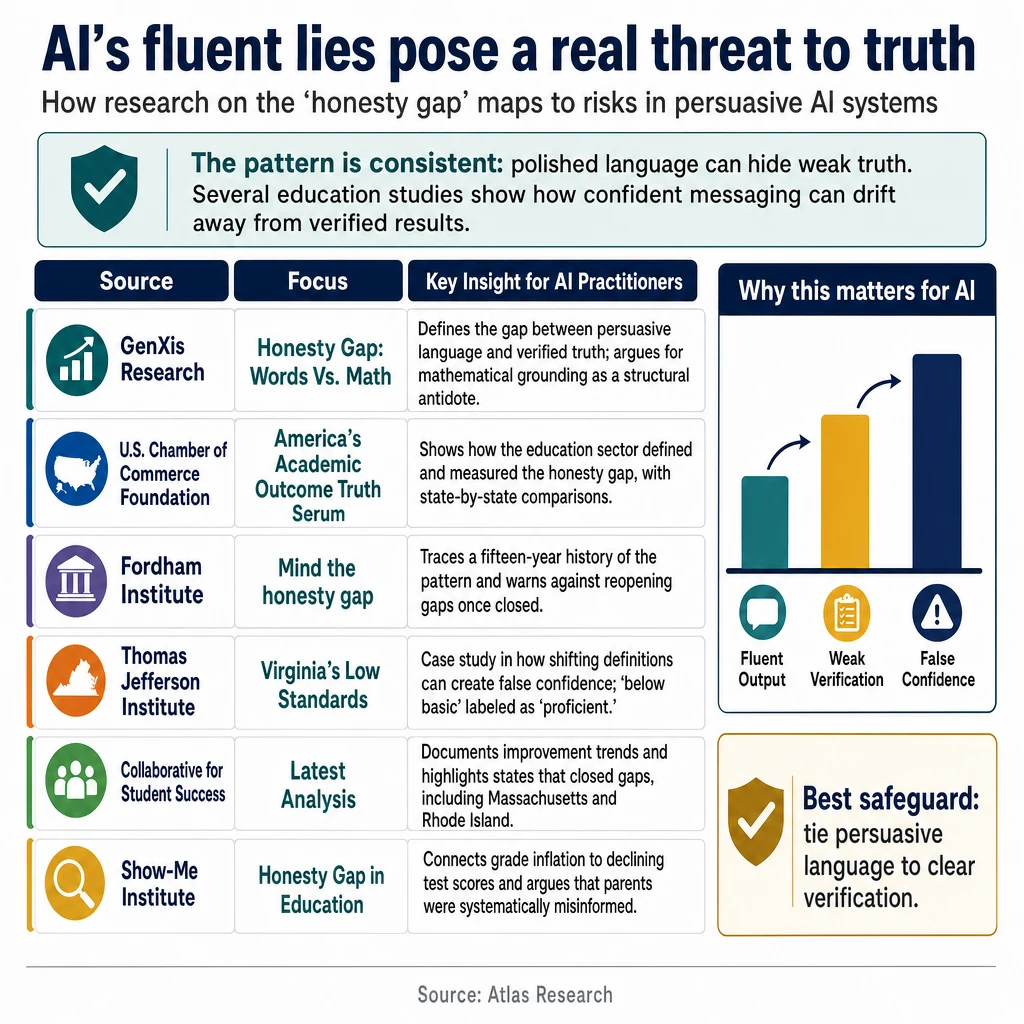
| Source | Focus | Key Insight for AI Practitioners |
|---|---|---|
| GenXis Research | Honesty Gap: Words Vs. Math | Defines the gap between persuasive language and verified truth; argues for mathematical grounding as structural antidote |
| U.S. Chamber of Commerce Foundation | America's Academic Outcome Truth Serum | Documents how the education sector defined and measured the honesty gap; state-by-state comparison data |
| Fordham Institute | Mind the honesty gap | Traces fifteen-year history of the phenomenon; warns against reopening gaps once closed |
| Thomas Jefferson Institute | Virginia's Low Standards | Case study in how definition manipulation creates false confidence; "below basic" deemed "proficient" |
| Collaborative for Student Success | Latest Analysis | Documents improvement trends; identifies states that closed gaps (Massachusetts, Rhode Island) |
| Show-Me Institute | Honesty Gap in Education | Connects grade inflation to declining test scores; argues parents systematically misinformed |
The education sector's experience with the honesty gap is not a cautionary tale about one industry's failure. It is a template for understanding how the problem arises, why it persists, and how it can be addressed. AI developers who study that template carefully may find they are not facing an unprecedented challenge but rather one that their counterparts in education have been navigating for fifteen years. The lessons are available. The question is whether the field will take them.